
Book Review
Ask yourself this question, and answer it honestly: Is it better to live in happy ignorance, or to know the facts about events that have shaped the world in which you live, even if the truth turns out to be sometimes disappointing?
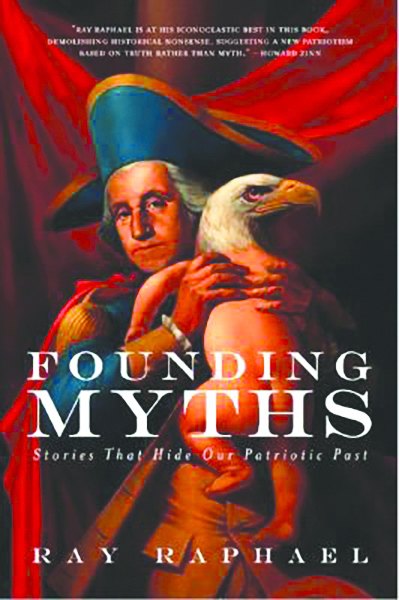
As we near the end of the 250th anniversary of our nation’s birth the answer to that question will in part determine how you feel after reading “Founding Myths,” a most remarkable book by award-winning historian Ray Raphael.
We Americans take great pride in the inspiring legacy left to us by those who, in the time of our Founding Fathers, declared our independence from the tyranny of an unjust king and Parliament; won a hard-fought victory against the world’s mightiest army; united thirteen separate colonies into a single free nation, and expanded that vision across an entire continent from sea to shining sea.
Every generation of school children since has learned such patriotic stories as those of: “the shot heard ‘round the world” that signaled the start of the Revolutionary War…Paul Revere’s ride to warn the townspeople of Lexington and Concord that the British were coming, and to watch for a lantern signal from the Old North Church, “one if by land, two if by sea”…Patrick Henry’s impassioned pleas to the Virginia colony’s Assembly, “Give me liberty or give me death”…the heroism of the Continental Army that unflinchingly braved the coldest winter ever at Valley Forge in loyalty to their General George Washington…the surrender of British General Cornwallis to Washington at Yorktown that finally ended the war…and so many other events.
Not one of the above is true as it has been taught to us over these many years! They are all myths, half-truths that have been embellished over time to suit the American public’s need for neat and tidy “feel good” imagery about our nation’s birth—and there are others, as well, including the fact that the Declaration of Independence was not the work of Thomas Jefferson alone…nor was it signed on July 4th, 1776, as is commonly believed.
Chapter by chapter, case by case, the author tells the true story behind each of these events, explaining what actually happened, and how the facts were later fictionalized—eventually finding their way into school textbooks, and even into books by otherwise respected historians who accepted these tales without doing their own research.
It’s important to note that the author’s purpose in bringing the truth to light is not to denigrate the achievements nor reputations of the individuals whose stories are told here. On the contrary, his intent is to suggest a new patriotism based on truth rather than myth, and to give more credit to the thousands of “common folk”—the forgotten farmers, shopkeepers, simple colonists—without whose support those in the Continental Congress and the military leaders could not have accomplished their task, and without whose roles there would today be no United States of America.
Of all the books I have read about our nation’s earliest days and the American Revolution, this is clearly one of the most enlightening, fascinating and entertaining. It is filled with surprises. Here is just a hint of the many you will find in these pages:
• On April 18th, 1775, a local silversmith, Paul Revere, was instructed by Dr. Joseph Warren (himself an almost forgotten true hero who, at the time, was one of the most popular and beloved patriots) to ride to Lexington and Concord to deliver a message to Samuel Adams and John Hancock that the British were coming. There was no reference at all to a signal from the Old North Church. Revere, on horseback, got as far as Lexington but on his way to Concord he was captured by a British patrol. They threatened to kill him but after they took his horse they let him go. Dr. Warren had sent other messengers, as well, some of whom eluded the British and did make it to Concord. When Revere later reported his own experience it was considered to be of no great importance and was not even included in official files. It was not until Henry Wadsworth Longfellow heard about the incident and wrote his poem, Paul Revere’s Ride, in 1860 exaggerating the facts that the silversmith’s name gained new fame.
• The Shot Heard Round the World was supposed to have been the opening salvo of the Revolution. “At dawn on April 19th, 1775, several hundred British Regulars, in full battle formation, opened fire on local militiamen. When the smoke had cleared, eight of the sleepy-eyed farmers who had been rousted in the middle of the night lay dead on the town green…To mobilize popular support, patriots proclaimed far and wide that the Redcoats had fired first…British authorities countered with their own official version: the Americans had fired first. Not surprisingly, this story received little circulation in the rebellious colonies…We have all learned that the British started the American Revolution when they opened fire on outnumbered and outclassed patriot militiamen on the Lexington Green. But this makes no sense. Revolutions, by nature, are proactive—they must be initiated by the revolutionaries themselves. The American Revolution had begun long before the battle of Lexington.” Earlier in the book the author discusses The Stamp Act riots in 1765, the Liberty riot in 1768, the resistance to occupying soldiers, the Boston Massacre in 1770, the Tea Party in 1773 and “various lesser-known demonstrations that were all orchestrated by Samuel Adams, master Revolutionary strategist.”
• It was March 23rd, 1775, a time when the British were building up their military throughout the colonies. A young representative to the Virginia convention, Patrick Henry, addressed the president of the convention with a speech that inspired all who attended, asking for a call to arms, pleading with his fellow Virginians to prepare for the inevitable conflict. It was a masterpiece of passionate conviction, and the sentence that would live for centuries was, “Give me liberty or give me death.” The problem is that Patrick Henry, who later became Governor of Virginia, was a great orator but not a writer. Not one of the speeches that he gave from 1763 to 1789 was written down nor recorded. That famous line did not appear until 42 years later when a man named William Wirt published a biography of Patrick Henry in 1817 so that “the young men of Virginia” would emulate the hero of his tale. As “Founding Myths” points out, with no record of Patrick Henry’s actual speeches available “Wirt filled in the blanks according to his own discretion.” So much for historical accuracy.
The examples quoted above are interesting, but they are far from the most important discussed in “Founding Myths.” I have intentionally left for you to discover on your own the most controversial—and, indeed, disturbing—facts about our nation’s early history. One chapter is—sarcastically, it seems to me–titled, Brutal British.
As the author points out, “The handiest way to justify intentional killing is to portray the opposition as brutal. In any war, stories abound of atrocities committed by the other side; violent acts committed by the protagonists (in this case, by the colonists) are merely retaliations for these foul deeds. This is the basic logic of warfare, and the American Revolution was no exception.”
The sad truth, however, is that some of the worst battlefield slaughters were committed by colonists against colonists! To understand this we must first realize that through the entire period of the Revolution the people were bitterly divided between those who favored independence from the British crown—those who called themselves Patriots—and those who, having lived their entire lives as British subjects and either confused, fearful or horrified by the actions of neighbors they perceived as what we today would call radicals or home-grown terrorists, referred to themselves as Loyalists, or Tories, and opposed independence while collaborating with the British forces and fighting in large numbers under their military leadership.
Some of the most horrific battles recorded in the Revolutionary War were between these two opposing armies of colonists, whose hatred for each other resulted in slaughters of men, women and children. Yet such events seldom if ever have made it into published histories and virtually never into school studies; they remain “myths of omission” because they do not fit into the mold of the memories we Americans like to hold dear to our hearts when we think of our nation’s earliest days.
There is one other I will mention here, an irony worth noting: While the American Revolution signaled the beginning of independence for the people of our new nation, it marked the end of independence for another people: the Native Americans who had made this their home for generations before the first Europeans ever arrived. While many of these so-called “Indians” had sided with the British in an effort to protect their lands against what they saw as encroachment by the colonists, many others joined forces with the colonists, hoping to come to a peaceful agreement in the event of a victorious outcome.
In one instance, “Chiefs from the Delaware and Shawnee pledged friendship with American patriots, hoping to work out some sort of accommodation with whites who bordered on their lands. Patriot officials offered these people assurances of support and protection, and they even suggested they would allow friendly Indians ‘to form a state whereof the Delaware nation shall be the head and have a representation in Congress’—one of the most disingenuous promises in the history of white-Indian relations. Patriots never did come through with any significant support, and white settlers continued to harass rather than protect indigenous people, friendly or otherwise, whom they encountered. After Indian-hating frontiersmen murdered four friendly Shawnee who were being held as hostages, the rest of the Shawnee joined with their militant neighbors—the Mingo, Miami, Wyandot, Chippewa, Ottawa and Kickapoo—in support of Britain.”
There is so much more in these pages, including clear and convincing explanations debunking the long-standing belief that the surrender of General Cornwallis at Yorktown effectively ended the war, when in fact it continued for years; the truth about the role played by the five-man committee assigned to write the Declaration of Independence, the sources referred to by Thomas Jefferson in preparing his draft; and what really happened during that bitter cold winter at Valley Forge that almost marked the end of the Continental Army, and with it the end of the Revolution.
The paperback edition of this book—published on the 10th anniversary of its writing—contains almost 70 pages of interesting reference Notes, as well as numerous reproductions of famous historical engravings. It also includes a closing chapter that discusses why these myths persist, one of which serves to give women a dramatic role in the Revolution.
As a reminder of his purpose in writing this book, the author closes with this thought: “The questions continue, or at least they should. That’s the only way we can clear the air. We might not learn exactly how it was in Revolutionary times, but we can free the people who lived back then from shackles placed upon them by later generations.”
Free yourself from the shackles of misinformation. You may be surprised how a truer understanding of what really happened will give you an even deeper appreciation of the miracle of our nation’s birth–a struggle not only against a superior outside force, but a steady, continuing series of difficult decisions and internal issues that threatened the tide at every turn.
When you think of today’s America, with our overwhelmingly negative political ultra-partisanship combined with the high-tech ability to propagandize through emails, social media, Artificial Intelligence and advertising sponsored by powerful moneyed interests, we are already seeing facts being twisted unquestioningly, and we can begin to wonder what myths future historians 50 and 100 years from now will be attempting to separate from fact.