
This is a romanticized story stirred up from deep in my memory bank from watching the news of the great February snows that blanketed the East Coast. The setting is the Blizzard of 1956. The backdrop was New York.
The call was straightforward. Everything with my grandfather was straightforward. “Mildred, I have no heat. It’s freezing.” And so began my march into heroism. It was March 19, I guess, the 2nd day of the Blizzard of ’56 in New York. I was 12. Like most boys of 12, I always wanted to be a hero, and I had plenty of TV shows to spur me on: Rin Tin Tin, Lassie, the Lone Ranger, Gene Autry, Roy Rogers, and the Rifleman. I had the desire; all I needed was the opportunity. The Blizzard gave it to me.
I idolized my grandfather. He was divorced from my grandmother and should have been. He was a roustabout with the libido of an alley cat. As the story goes, my grandmother’s sisters told her that either he had to go or she had to go. Highland Park, NJ, would not stand for a scandal. Why idolize such a person? Well, I was a boy, and in my eyes, he was a tough guy. He called me kid. He returned from the Pacific Theatre to become an international toy salesman, and when he’d drive up to our house in Brooklyn in his Hudson, he’d toss me the keys and say, “Here, kid, catch. Go look in the trunk.” And in the trunk were always wonderful things. Another story was that he got arrested in a bar when some guy made an anti-Semitic slur, and he knocked the guy flat from his barstool. He had white hair, smoked Camel cigarettes, which eventually killed him, and read True Detective Magazine with what passed then for salacious pictures of women. He’d let me read them when we visited him in the city.
Part of his mystique was how he lived. At first, he lived in a small hotel in midtown Manhattan. He rented a room. The hotel staff serviced it as if he were a guest. I thought it was pretty cool. I never knew anyone could live in a hotel. He then moved further downtown to a one-bedroom apartment. The living room had a bookstand, and it was there that he stashed the magazines. Born in Russia, he had left the family after it emigrated to New York. At one point, he imported ostrich feathers to the hat-making trade. He also exported them. I saw him as someone who could be an extra in a black-and-white Humphrey Bogart movie, so when the distress call came, I was ready to leap to his aid. The problem was I was 12.
The plan was simple. My brother, five years my senior, and I would take our electric heater, which was the size of a small suitcase and weighed as much as one fully packed, and take it to him. We would take the subway. He lived on W. 17th Street. My mother bundled me up like I was going to Alaska. Looking back on it, I looked like the Michelin Man wearing rubber galoshes, the ones that had the metal snaps across the front. As it turned out, Alaska might have been easier. It was a six-block walk to the subway; the snow was in different places, varying degrees of deep. Sometimes it was knee-high, sometimes thigh-high, and never was it easy to walk through. When you’re a kid, starting an adventure is exciting. You’re braving the elements, beating the odds. Being a hero seemed like a wonderful thing to be. By the time we had lugged this thing to the station, I was realizing that maybe being a hero was best done by watching TV than acting the part. And we had only just begun.
Things got worse. When we reached the train, an announcement was made. Due to the continuing snowfall, the train would be making only local stops, and its last stop would be on the other side of the bridge. The good news was just that. Walking across the Brooklyn Bridge in a snowstorm was not a good idea, and I doubt the cops would have allowed it. The bad news was that it was a more than 17-block hike, in the snow, carrying the heater, to grandpa’s.
One of the things you learn about strenuous work in the winter is that no matter how cold it is, you work up a sweat. So, there I was, bundled up, sweating like a pig, as we used to say (do pigs really sweat? ‘don’t know.), counting the minutes when it would be my brother’s turn to again carry our freight.
We made it. My grandpa had a gas stove and hot chocolate. He was the least likely person in my mind to have hot chocolate, but boy, was it welcome.
Then came the trek home. We couldn’t stay too long because my mother had made it plain we were to be on the way home before sunset, and in winter, that’s early. I wouldn’t say the return trip was much fun. Easier without heater, yes, but fun, no. It was cold and getting colder. I looked like the Michelin Man, but my nose was unprotected and was soon red as Rudolph’s. Why one’s nose runs in the cold when every other liquid freezes, I don’t know, but run it did, like a faucet. Wearing mittens, I couldn’t get my hands in my pockets, not that I was likely to have a tissue in them. Boys don’t carry tissues.
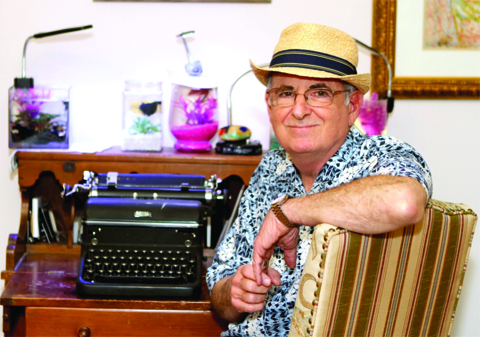
We got to the train and the train got us home. When all was said and done, I decided I liked being a hero. Columnist and author Bill Gralnick was born and raised in Brooklyn, NY. He recently finished a humorous memoir trilogy. The first book is “The War of the Itchy Balls and Other Tales from Brooklyn.” The second is “George Washington Didn’t Sleep Here.” The recently published third is, That’s Why They Call It Work.” He is currently working on a novel. His books are available on Amazon and his other writings at https://www.williamgralnickauthor.com.