
Last month, I wrote about writing. This month, we explore reading. I’m not one for lists. I will do a grocery list. It goes from pencil to pocket. Then all I have to do is remember which pocket it’s in when I get to the store. There’s little chance I’ll lose it. I don’t make New Year’s resolution lists. I long ago learned that they are a ticket to becoming guilt-ridden. I rarely make to-do lists because I mostly don’t get them done. When I turned 65, longer ago than I’d like to admit, the subject of bucket lists came up. I thought maybe this was a list that I should do, so I began to compile lists of things I wanted to get done before I have to deal with the Great Gates. In short order, I realized I’d have to live as long as Methuselah and win the lottery to get through even a part of the list. And unfortunately, the bucket had a hole in it. The things I put in kept leaking out. I felt, though, that a bucket list could be good for my mental health, so I tried to find one subject to which I would dedicate myself. I found it, reading.
Such a list made more sense than one that said, “play more tennis,” or “learn how to play Pickleball,” or, “forget Pickleball, learn Padel.” My wife is an avid card player. She wanted me to learn how to play canasta or mahjongg. It didn’t take long to realize I had no mind for cards, and having one’s spouse become one’s teacher is a ticket to a rocky marriage. I even registered for a class at my synagogue for learning canasta. Almost everybody who came already knew how to play. The woman teaching the class said she had only been playing for two years and told everyone who had played longer than that to go fill the tables in the back and play amongst themselves. When that happened, the remaining people were an extremely cranky woman and me. Sometimes God speaks to you. He was definitely telling me to erase card-playing from my list. Reading was going to be the winner.
I have always loved reading. I began to think about a reading list. The question became did I know the names of enough books that I wanted to read to create a list? The answer was no. I could easily have chosen an author like Stephen King, whose writing I love, and just read all his books. But I wanted more of a challenge.
I don’t know how I stumbled across it, but I became aware that there were lists of “best books” by categories. The 10 best mysteries, the 50 best love stories, and so on. Then I found the one that was for me. England’s prized Guardian Magazine had created a list of the 100 best books written in English. Since that was the language I was going to read in, what better magazine to be the judge of what’s best than an English magazine? The books begin in the mid-1600s with Pilgrim’s Progress and run through the 1980s. They have updated it, but I didn’t know which number book after 100 would be the one that breaks this camel’s back, so I decided to stick with what I had and, if I got through a hundred books, I’d decide if I wanted to continue on. When I first began, I didn’t think I would ever finish. A one hundred book list is intimidating. But reading good literature, sometimes even not so good literature, can be addictive. One day, my wife asked me how many books I had read. I guesstimated about half. Then I got curious. You see, the wonderful thing about this list is I can’t lose it. Guardian Magazine printed it. I copied it onto my computer and saved it. It’s always at my fingertips. I put an X next to every book when I finish it. I often forget titles—and authors’ names? Fuhgeddaboudit! Now I don’t even have to remember them; they’re on my list. So, I decided to count my Xs. In fact, I was past 50 and close to 70. Mathematically, that’s great, but realistically, it means I still have about 30 books to go.
When I started, I decided not to go from first to last but to jump around, reading a few books from one period, a few more from another, a couple from the third. It’s fascinating to see how writing has changed, which themes were prevalent at different periods, and how the expression of feelings and emotions has changed. Some of the books are fairly short, about 350 pages on my Kindle. The average book seems to be about 500 to 600 Kindle pages. However, there are a daunting number that exceed 1,000 pages. After finishing a few books, I noticed that the Kindle folks were asking for a review. Once upon a time in my career, I wrote book reviews for the then Atlanta Constitution. I enjoyed it, and my editor told me I was good at it. I have added this as a “plus-one” item to my reading. I have just finished a 1,200-page book that was so good I didn’t want it to end. It is a book whose title you know and one you may have read in high school or college. The book is David Copperfield by Charles Dickens. Here is my take on it.
My brother, a TV news journalist at the time, used to tease me about my writing. He said quote you write like Charles Dickens. You never met an adjective or adverb you didn’t like.” Would that he was right about the Dickens part. I do love his writing. Why? Is there a writer who uses the alphabet better than Charles Dickens? If you want characters who have stayed with us for centuries, if you want those characters to leap off the page and perform on a stage in front of your eyes, if you want laugh out loud humor and droll sarcasm, if you want melancholy that will cause a lump in your throat or excitement that will quicken your heartbeat, or a basket brimming full of metaphors and similes such as this—“His legs were so long and he was so thin that standing there he looked like somebody else’s shadow—,” if you want a book that you’re sorry to see end then you want to read Charles Dickens. David Copperfield, described above, a novelized autobiography of a 1,000-plus kindle pages, was Dickens’s favorite. Mine too.
So, it’s on to number 72–George Orwell’s 1984, a mere 360 Kindle pages. ‘piece of cake.
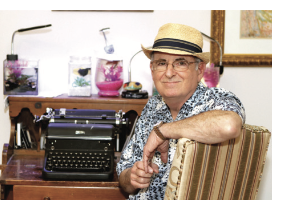
Columnist and author Bill Gralnick was born and raised in Brooklyn, NY. He recently finished a humorous memoir trilogy. The first book is “The War of the Itchy Balls and Other Tales from Brooklyn.” The second is “George Washington Didn’t Sleep Here.” The recently published third is, That’s Why They Call It Work.” He is currently working on a novel. His books are available on Amazon and his other writings at https://www.williamgralnickauthor.com.