



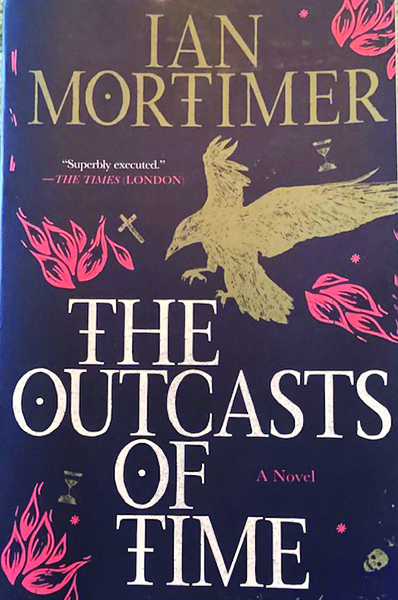
The Outcasts Of Time
Several years ago, I very much enjoyed and highly recommended in this column a book, The Time Traveler’s Guide to Medieval England, a wonderfully original approach to history writing by presenting it in the form of a current type of travel guide for anyone who wants to visit a foreign country and needs to be familiar with the local customs, currency, places to see, politics, language, status of medical knowledge and so on.
The author, Ian Mortimer, is an award-winning Fellow of the Royal Historical Society and a Fellow of the Society of Antiquaries in England.
When I became aware of this later novel by the author, I knew immediately that it would be another treat, but that has turned out to be an understatement. For The Outcasts of Time is clearly one of the most impressive, most creatively conceived and reflective of a range of historical knowledge about its subject that stands out among any literary work in my memory.
The story begins on Tuesday, the 16th of December in the year 1348. A man in his mid-30s, John of Wraymont is walking home to his wife, Catherine, and their children together with his brother, William. John is a stonemason, a religious man who carves small statuary for the local church. But this is a time of great sadness and grief: the plague—the Black Death—has spread across the land, and as the brothers travel the roads, they are surrounded by corpses both human and animal who have been infected and died on the spot, their bodies marked by the fearsome warning sign of black spots.
John and William are still more than a mile from home when they hear the mournful wailing of an infant and carefully follow the sound, approaching a dead man and woman on the side of a road to discover a naked baby crying in hunger for its mother’s milk. Despite William’s fears, John’s compassion prompts him to rescue the helpless child in the hope that they will find a wetnurse to take over on the way home.
Instead, an invisible voice—which John understands to be a messenger from God—informs them that they have been infected and now have only six days to live but are being given a choice: They can either continue to live out those six days in their own time … or, they can live one day at a time, six more days, on the same day of the year once every 99 years! So, for example, when they go to sleep that night they will awaken on December 16, 1447 … and so on until the year 1942—always in the same town and area of John’s birthplace, which of course changes dramatically and unrecognizably over time. That is what John and William decide to do, rather than return to John’s home and family with the possibility of causing them harm.
It is an intriguing concept, a journey across the centuries that is told primarily in John’s voice, which is replete with words and phrases common in 14th Century England so that they sound strange to the people they meet in later times—and which some readers of this book may find halting at times. But to me that device contributes even more to the atmosphere of the adventure and never presents any real problem.
On each day of their awakening John looks for a way to do a good deed in the hope that this will ensure God’s acceptance of him into Heaven. But as they try to explain their odd ways and presence to a series of centuries of new strangers, they experience reactions that range from gentle kindness to unbearable cruelty and suffering.
We share the shock of witnessing for the first time human voices coming from a small wooden box … an iron wagon with people in it, moving along the road without a horse pulling it … and then a flock of crosses floating across the sky with people inside them … and so much more.
On the final day—after John awakens to find a caring young nurse taking him home from a hospital to provide a needed meal and tea he sees some photos on her mantelpiece, recognizes and names the people in them: the churchman Father Harrington and family, who had treated him warmly and kindly just the day before. The nurse is stunned. That’s impossible, she tells him. Father Harrington was her grandfather; he died many years ago, long before John was born!
And so it goes for the time travelers. But end it must. And when you turn the final page I believe you will be as grateful to Ian Mortimer for the time he devoted to writing this book … and happy about the time you devoted to reading it.
Now if someone in Hollywood will take the time to make a film of this remarkable story!