

In this issue, we are pleased to share “MDA: The Beating Heart of Israel’s Courage,” an article by James Ogunleye, published in The Times of Israel.
From battlefields to birth rooms, the medics and midwives who keep showing up
I have written here before about Israel’s everyday angels – the volunteers, soldiers, neighbors, and strangers who step into the breach when life turns upside down. But there is one group I have been saving for its own tribute, because nothing else would do them justice: the heroes in white, the men and women of Magen David Adom.
If you have ever stood at the side of a road, watched an ambulance tear past, lights flashing and sirens cutting through the air, you know the feeling – that quickening in your chest that says, help is on the way. For Israel, on October 7 and in every exhausting, terrifying day since, that help has had a name: MDA.
I have met volunteers, soldiers, and innovators of every kind. But there is something about an MDA medic that defies easy description – a blend of steel and tenderness, urgency and calm. On October 7, when so many of us froze in disbelief, MDA teams were already in motion, racing towards the danger.
Take Alisa Krant, just 23 years old on the morning the world changed. Sirens in Ashkelon at dawn, dispatches into combat zones within the hour. She and her crew moved wounded civilians and soldiers under fire, performing life-saving procedures in bulletproof ambulances. At one point, she kept a gravely injured police officer alive with a thoracentesis as rockets roared overhead. He had rescued two little girls whose parents had been murdered; now she was rescuing him. Later, they would become friends, bonded by trauma, resilience, and a shared understanding of what it means to simply show up.
Alisa did not go home and decide she had done her bit. She returned to the field, leading responder training programs, all while earning her degree in industrial engineering. “When you have a why,” she says, “you can bear any how.” It is a sentence that could be engraved on MDA’s shield.
Then there is Chaya Lock, a Manchester-born palliative care worker who came to Jerusalem for a temporary post and stayed. When the war erupted, she could have gone home. Instead, she enrolled in MDA’s English-language training program and joined ambulance crews across the country. She learned Hebrew under pressure, treating car crash victims, rushing newborns to hospital, navigating the most human and heartbreaking scenes. Sometimes, she says, she was the oldest responder on the scene – and marveled that “this country is being run by kids, but it works.”
One of her toughest calls involved saving the life of a Palestinian baby whose parents were in Israel illegally. Chaya and her bat sherut partner worked frantically to keep the child alive en route to hospital. When they handed the baby over, police were waiting. “Who will this child become?” she wondered aloud. In that moment, she was not thinking about politics or policy – just the fragile thread of life in her hands. This, too, is Israel.
And then, of course, the luminous Tehila Kadosh and Mera Bokae, both honored this summer by President Herzog for extraordinary service. Tehila, a paramedic and rapid response training coordinator, worked extra hours under rocket fire during the war with Iran, leading advanced emergency medicine courses in between missions into missile strike zones. Mera, a senior EMT from Akko, has earned the trust of her colleagues not just for her skill under pressure, but for her quiet, meticulous care – making sure every emergency vehicle in her station is fully equipped and ready to roll.
But MDA’s courage is not confined to battlefields and bomb shelters. In a remarkable example of innovating the future of Israel, they have turned their lifesaving reach to one of the most human moments possible – childbirth – under some of the most inhuman circumstances.
Last year, during the Hezbollah rocket barrages in the north, MDA and the Israel Midwives Organization launched the First Contractions program. It began with just 60 volunteer midwives – Jews, Arabs, and Druze – each paired with expectant mothers in their communities in case war or blocked roads made reaching a hospital impossible. Now, that initiative has expanded nationwide, with more than 200 trained midwives equipped with full birth kits, portable ultrasound dopplers, oxygen tanks, and neonatal resuscitation gear.
In 2024 alone, MDA teams helped 1,156 women give birth in their homes or en route to hospital. That number is not just a statistic – it is a thousand stories of life beginning even as sirens wailed overhead. It is the essence of resilience and renewal: mothers bringing children into the world while rockets fall, and a network of midwives standing ready to catch those first cries.
One of those midwives, Gilat Dolev from Kfar Tavor, says it best: “It’s important that midwives are available not only during emergencies but during holidays, when women might not make it to the hospital.” She is ready, at any hour, to drop everything and bring new life safely into the world. It is a mission as urgent as any trauma call – and every bit as heroic.
What unites these women, and the thousands of MDA medics, drivers, dispatchers, and now midwives, is not just professional excellence. It is the conviction that someone must go towards the need. And if not them, then who?
Since October 7, MDA has lost more than three dozen of its own. Still, they keep showing up. Still, they drive into rocket fire, into ambush zones, into shattered buildings, into moments when seconds mean the difference between life and death – or into living rooms where a new Israeli is seconds away from taking its first breath.
Every MDA uniform tells a story. Some are worn by teenagers fresh out of high school, learning to triage on their first accident scene. Some by veterans of countless emergencies, who can calm a hysterical parent or improvise a field treatment with the ease of muscle memory. Some are worn by immigrants like Chaya, who arrive speaking another language but soon master the Hebrew of emergency commands: tachuf – urgent; nashima – breathe.
And yet, MDA is not just the sum of its individuals. It is a national force that binds us. In an ambulance crew, you might have a secular Tel Avivian, a religious girl from Efrat, an Arab driver from the Galilee, a Druze midwife from the north, and a lone soldier from Los Angeles – all working seamlessly. There is something quietly profound in that.
I once listened to a survivor who said he asked an MDA volunteer why she kept going back, knowing the risks. She smiled and said, “Because I can’t imagine being anywhere else when someone’s life is on the line.” That is it. That is the whole mission.
We owe Magen David Adom more than gratitude. We owe them our support – in funding, in equipment, in making sure every medic, every midwife, knows that we see them. That we remember that on October 7, and every day since, they have been there for strangers, for soldiers, for children, for mothers in labour; for all of Israel.
So here is to Alisa, to Chaya, to Tehila, to Mera, to Gilat, and to the thousands of others whose names we may never hear but whose hands have steadied Israel in its hour of need. You are not just saving lives; you are stitching the torn fabric of the nation, one act of care at a time.
In Israel, people say kol hakavod to mean “well done.” To Magen David Adom, I say something more: May you never need to answer another call born of violence. But if the siren wails, may you always have the strength, the courage, and the grace to answer it.
Because in the story of Israel’s courage, MDA is not just a chapter, it is the lifeline.
If you’d like more information or to get involved in our efforts, please feel free to reach out to Yishai Mizrahi or Leslie Viselman, Co-Area Directors for AFMDA, at 561.212.7495 or via email [email protected].
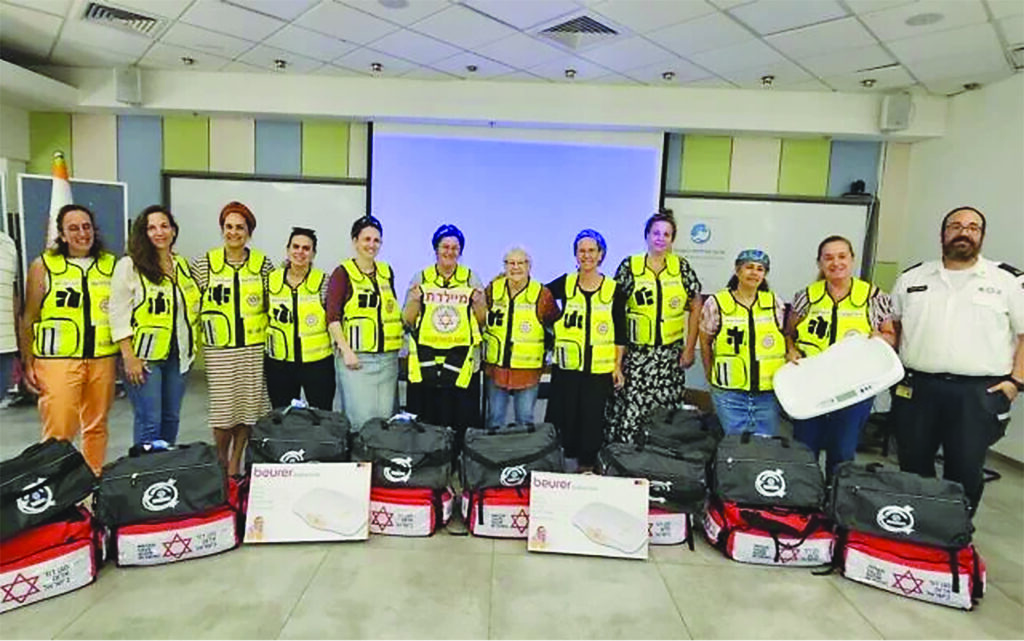
From sirens to lullabies – volunteer midwives of MDA’s “First Contractions” project stand ready with birth kits in hand to reach mothers in labour when hospitals are too far, roads are blocked, or rockets are falling. In war or peace, they carry the quiet power to deliver life where it is needed most. (Photo credit: Times of Israel/MDA)